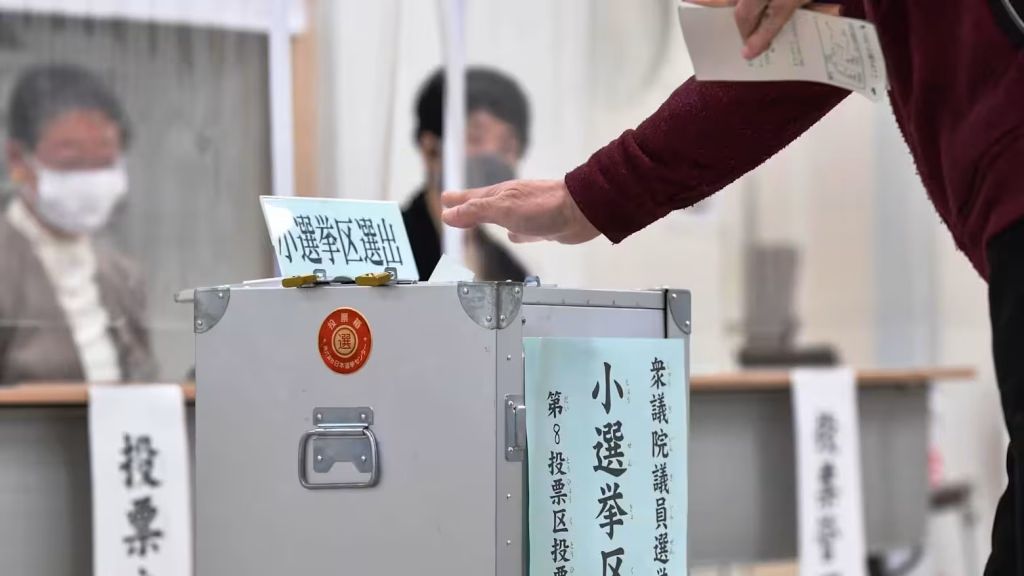
Fukuoka will hold its first repeat mayoral election after none of the 13 candidates in Sunday’s (Nov 15) contest secured the minimum vote share required under Japanese law.
According to KBC, no candidate managed to obtain at least 25% of the valid votes, leaving the election without a winner.
Voter turnout stood at 45.58%, up from 34.31% in the previous mayoral election four years ago.
Top five candidates and election results
Independent candidate Shuji Inatomi, 56, topped the poll with 137,667 votes, or 23.23%, but fell short of the required threshold.
The other leading candidates were:
-
Masaru Niimura, 46, an independent and former Fukuoka city councillor, with 93,824 votes (15.83%).
-
Kentaro Mori, 48, of the Japan Conservative Party, with 93,206 votes (15.73%).
-
Takashi Shirabe, 48, an independent former city councillor backed by the Liberal Democratic Party’s city council group, with 71,964 votes (12.14%).
-
Genki Jinno, 41, an independent education entrepreneur and school principal, with 48,195 votes (8.13%).
Inatomi, a former national legislator, campaigned on cost-of-living relief, stronger public transportation and making Fukuoka a designated secondary national capital.
Niimura advocated continuing much of outgoing mayor Soichiro Takashima’s development agenda while addressing housing costs, childcare and public transport congestion.
Mori campaigned on tax reductions, spending cuts and restrictions on municipal support for foreign residents, including a proposal to end public assistance for foreign nationals.
Shirabe emphasised economic development, housing affordability and improved transport infrastructure, while Jinno focused on education reform, childcare support, affordable housing, welfare services and more accessible transportation.
Why no candidate was declared the winner
Under Japan’s Public Offices Election Act, a candidate in a mayoral election must secure at least one-quarter of the valid votes to be elected.
Although the threshold is below a simple majority, finishing first is not sufficient to secure victory.
With 13 candidates dividing the votes, none managed to cross the 25% threshold. Inatomi, despite finishing first with 23.23%, fell approximately 10,500 votes short.
What happens next?
The next contest will be a repeat election rather than a runoff limited to the two leading candidates.
Following a 14-day objection period, another election must generally be held within 50 days. However, the election commission has yet to officially confirm the date.
The repeat election will be an entirely new contest. Previous candidates may run again, withdraw or endorse other candidates, while new contenders will also be allowed to enter the race.
The same 25% requirement will apply if the next election also fails to produce a winner, meaning further repeat elections could be necessary. There will be no automatic reduction in the threshold.
However, if only four candidates contest the election, at least one must mathematically secure 25% of the valid votes.
The cost of holding another election could also influence the next contest.
FBS reported that approximately ¥830 million had been budgeted for November’s election, while each candidate must provide a fresh deposit of ¥2.4 million to contest the repeat election.
Candidates who receive less than 10% of the valid votes will forfeit their deposits.
Repeated campaigning would also mean additional expenses for candidates and taxpayers, potentially encouraging some contenders to withdraw, endorse other candidates or cooperate with one another.
What this means for Fukuoka
Four candidates secured more than 10% of the votes, while the remaining nine collectively accounted for roughly one-third of all valid ballots.
The distribution of votes leaves several questions for the next election, particularly whether supporters of candidates who withdraw will transfer their support to other contenders, and whether the leading candidates can broaden their support to cross the 25% threshold.
Candidates with limited support could face greater financial and political pressure to withdraw or cooperate with others.
However, consolidation is not inevitable, as some may choose to remain in the race to advance particular issues, represent their supporters or build longer-term political movements, even if their chances of winning are limited.
Meanwhile, Takashima’s four-term, 16-year tenure as mayor is approaching its end, with his current term due to expire on Dec 6.
If no successor has been elected by then, one of Fukuoka City’s deputy mayors will temporarily perform the mayor’s duties under Article 152 of Japan’s Local Autonomy Act.
The deputy mayor will serve in an acting capacity rather than become the elected mayor, allowing city administration and essential services to continue until a new mayor takes office.


